Whenever an audience is interested in hearing about the United States Navy, it is both an honor and privilege for me to share my experience and knowledge.
The navy is a 235-year-old institution. It has 600,000 personnel (400,000 military and 200,000 civilian) with a $160 billion budget. Our fleet consists of 291 ships and 3,700 aircraft. 169 ships are underway or 58% of the fleet, including 36 submarines at sea.
Whereas other branches of the military need permission from a foreign government to fly over or establish a footprint on shore in order to operate, the Navy operates at will in international waters by maintaining sea supremacy. 74% of the earths surface is covered by water. This is our operating domain. 120 nations have a water boundary, 2/3 of the worlds population lives within 80 miles of water and no point on earth is more than 1700 miles from deep blue water. Therefore, our presence can be felt in most places on the globe. Open sea lanes are vital. On any given day, thousands of merchant ships sail the oceans, as it is the least expensive method for shipment. $700 billion annually, 90% of the world trade is transported by sea and 4 million jobs stem from this activity. Much of our raw material is not domestic and must be imported by sea to maintain our defense and industrial base. Sea power is what sustains and protects our economic might.
Two primary navy missions are Sea Strike and Sea Shield. Sea strike – project force to deter an aggressor with bombs on target in a precision attack. Sea shield – protect the homeland through missile intercept capability at sea, stopping a warhead long before reaching our shores.
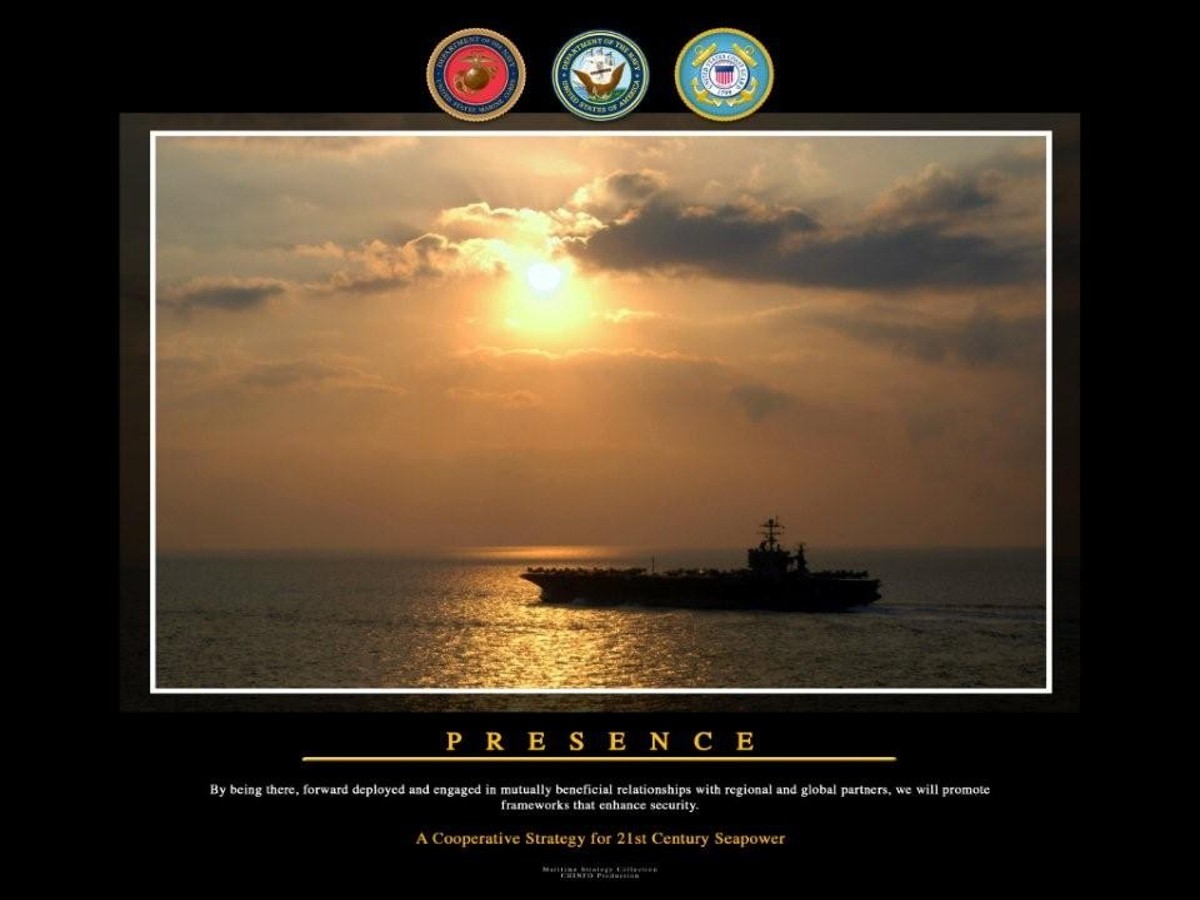
In a broader perspective the navy is an extension of foreign policy. When diplomatic relations are tense, the President has the option of strategically placing a battle group in a regional hotspot to help influence diplomacy and if discussions break down he has a tactical military option readily available.
Because of our capability to sustain a forward presence at sea for long periods through underway replenishment, our presence and supply chain allow an additional mission of humanitarian assistance. After the tsunami in Indonesia, we were on scene with food, water and medical attention. Similarly, in Haiti after a 7.0 earthquake, we were there, and the USS Iwo Jima with an embarked construction battalion remained on station building infrastructure. Recent flooding covered 20% of Pakistan and we offered food relief. 7,850 people were rescued, 1,700 lives were lost and 17 million people affected. As you can see, we can be a resource for peace or war.
Thomas Friedman stated in his book Lexus and the Olive Tree: There is a new era of globalization, different from the early 1900s. That era was dominated by British power, its currency and its navy. Todays era is dominated by American Power, currency, and the US navy. After WWII, the US economy grew through international trade. It was the American fleet that kept the sea lanes open for markets to connect.
Sea Power is what we are all about. It enables us to keep the sea lanes open for our military logistics chain to support a forward deployed army as well as to keep the economy of our nation thriving. There are always obstacles. Obstacles today include terrorism (you may recall the USS Cole attack in a Yemen port) and piracy, although a non-issue for years, has risen as a current threat. The year I retired there were 127 acts of piracy; an average of one every three days, and pirates have been emboldened by their success.
The US Transportation Command is located in the St. Louis metro area at Scott Air Force Base. It is headed by a four-star general and is one of only 10 combatant commands reporting directly to the Secretary of Defense. Transcom is made up of three component commands: Air Mobility Command, Military Sealift Command (the Navy component), and Deployment Distribution Command. In a joint mission Transcom is one of the first commands contacted. Transcom is DODs Supply Chain agent responsible for getting material from the supplier to the end user in the field.
Scott Air Force Base employs 14,000 people and contributes $2.2 billion annually to the regional economy. The dollar value of jobs is $254 million with an additional 6,000 indirect jobs created. Air base folks spend $145 million annual on housing and 105,000 hotel rooms are occupied by people associated with Scott AFB. The air base is the 3rd largest employer in the metro area and it is expanding. The 2nd largest employer is Boeing, a defense contractor, receiving 18%, or $6 billion of its annual revenue from the Navy. When you consider these employers, subcontractors and businesses supported indirectly by their employees, you can see the impact on the St. Louis economy is significant.
This should provide insight to the Navys maritime strategy and its far-reaching economic impact even here in St. Louis.
Q and A discussion: 1) Naval Operations in the Arabian Sea in support of Afghanistan. 2) Choke points in the Persian Gulf, specifically, Straights of Hormuz, potentially disrupting 20% of the worlds oil production and 40% of oil shipped by sea. 3) KoreanPeninsula tension. 4) Chinese naval expansion and concern over Yellow Sea operations. 5) Exercises with allies and other countries. 6) Naval History and cycles of expansion and contraction – e.g. President Teddy Roosevelt’s Great White Fleet.
If you are interested in contacting me, please visit my website at
williamschas.com